From The Ground Up Pioneers a Shift in Who Leads Agricultural Research
For decades, agricultural research has followed a familiar path: designed by academics, tested in controlled settings, and results shared with farmers through extension networks. But across Ohio and Missouri, that model is being turned on its head by the From The Ground Up (FTGUp) project. This time, the ideas originate from working farmers, with research and extension networks supporting their on-farm innovation.
Started in 2024 with a $10 million grant from the USDA National Institute of Food and Agriculture, this farmer-led project is working to improve the performance of conservation practices on Midwestern farms. Farmers have chosen research questions about conservation practices they want answered empirically and are working with scientists to gather results on their own land.
This on-farm research is being supported by researchers and extension educators at The Ohio State University and Central State University in Ohio, and the University of Missouri and Lincoln University in Missouri. Together with the non-profit Solutions from the Land, this farmer-researcher collaboration is seeking to document outcomes and identify innovative solutions that address performance gaps across different types of farms in each state.

Adam Boman of Good Life Grass Farms, a sheep and grass-fed cattle farmer who runs a 160-acre operation in Pierce City, Missouri, says the idea initially sounded unrealistic when he was approached to join the research. “I was told that the farmers were going to be able to design the research. And I was like, ‘oh, that sounds too good to be true.’”
But that skepticism quickly turned into belief as the project delivered exactly that, putting him and farmer-neighbors in the driver’s seat. Boman recruited five other ranchers in Southwest Missouri. They met as a group to decide their research questions, invited the university scientists to help them design a research protocol, and are now measuring how different soil amendments impact their pastures.
“The purpose was to have it be led by farmers. So the research would be more applicable and more producer focused. I think it’s pretty powerful coming from a real-world example compared to traditional research that may not relate well to some of the real-world situations.” Other farmers were inspired to join by the very idea of it being a farmer-led research project “I decided to get involved with FTGUp because I love the idea that there is actual research that is being conducted on the farm by farmers,” says Donee Boykin, founder of Endigo’s Herbals & Organics, LLC in Trotwood, Ohio, who grows tomatoes, okra, herbs and a variety of other specialty crops on her one-acre farm.
“In FTGUp, through design meetings, we built our own study protocol. We decided what questions actually matter, what methods make sense, and what information would help us improve our practices.”
Boykin says FTGUp is elevating the voice of farmers whose experience and insight too often go unheard in the decision-making rooms that shape agricultural policy and practice. “To me, FTGUp is lifting up the farmer voices. Farmer-led research is going to shift how the agriculture community sees us and how they value our knowledge. Farmers are the hands-on deck. We’re the feet in the dirt… When research starts with farmers, you get real solutions.”

Why farmer-led research?
Research shows conservation practices such as cover crops, diversified rotations, reduced tillage, and integration of livestock and crop production can improve environmental outcomes, yields, and resilience. But adoption remains low due to inconsistent on-farm performance and limited incentives. This project is examining how these practices perform in real-world conditions and pays attention to factors both on and off the farm that are needed to support wider adoption.
Early project milestones focused on ensuring authentic farmer co-creation. “The best thing over the last two years has been the active engagement and ownership of the project by our farmer leaders and collaborators. I’ve been thrilled to hear them talk publicly about how different their experience has been on this project compared to prior on-farm research collaborations,” says Dr. Douglas Jackson-Smith, Project Director for FTGUp and Professor and Kellogg Endowed Chair of the Agroecosystem Management Program at The Ohio State University.
Dr. Gurbir Singh, Assistant Professor and State Extension Specialist in Soil Science and Institutional Lead for the FTGUp project at the University of Missouri, describes the first two years as a breakthrough in collaborative efforts. “FTGUp has delivered true co-production. This collaboration strengthens scientific thinking on both sides and broadens researchers’ views of real-world constraints. It has provided a meaningful learning experience for everyone involved.”
For Ernie Shea, President of Solutions from the Land, “one of FTGUp’s most significant accomplishments has been the success we have achieved in recruiting a diverse group of farmers who are actively helping to co-create and implement the on-farm experiments. I am most excited about the diversity of FTGUp’s experiments.”
FTGUp as a direct answer to long-standing agricultural problems in Ohio
Over the last two years, ten groups consisting of five to eight farmers have been formed across Ohio and Missouri. In Ohio, one group is comparing the impacts of cover crops versus no cover crops on crop quality in small-scale vegetable production systems. Another is comparing the effectiveness of planting small-seeded diverse cover crops by drone into standing crops versus traditional drilled rye, as well as no cover crop, within conventional corn and soybean systems. A third group is exploring the impact of harvesting versus plowing down peas and clover within organic crop rotations. Another group of conventional dairy farmers is comparing a traditional, terminated cover crop with intensively managed winter triticale harvested as forage to see the comparative impacts on soil health. A fifth group is evaluating different approaches to fungicide use in conventional corn and soybean production and their impacts on crop yield and soil health.

On a 300-acre, sixth-generation dairy farm in Rittman, Ohio, Shane Hartzler of Crossroads Dairy sees farmer-led research as a direct answer to long-standing agricultural problems. “Sometimes there can be a disconnect between the research being done and how it applies to my own farm. I like FTGUp because it shows me what I’m looking for right here.”
But beyond the data the research will generate, Hartzler sees farmer-led research as an effective method for enhancing trust and encouraging adoption of research results. “Farmer-led research definitely impacts other farmers’ willingness to look at research findings and apply the practices because we tend to believe other farmers more. If I can show on my farm the practice means more yield or something like that, I would say that other farmers listen to that.”
Dr. Sakthi Kumaran, Research Associate Professor of Soil Sciences and Agronomy, and FTGUp Institutional Lead at Central State University agrees. “We have earned the farmers’ trust more. They see how researchers are more interested in helping answer the research questions that they have. It is a paradigm shift in the mindset. That is important for increasing the adoption of regenerative agricultural practices.”
What farmers are testing in Missouri
In Missouri, three groups are focused on pasture management. One is comparing different methods of pretreating seeds for broadcasting warm season annual cover crop species into pastures grazed by small ruminants. Another is evaluating the impacts of worm castings, foliar applied organic fertilizers, and traditional nitrogen sources such as urea, as soil amendments on rotationally grazed pastures. A third group is looking at the pros and cons of different ways of managing mid-season fescue and their interactions with liming.
Two of the Missouri groups are focused on cover crops. One involves corn and soybean farmers who are comparing the crop yield and soil health outcomes from using winter cover crops versus no cover crops in conventional rotations. The second is a group of small-scale vegetable producers in the Bootheel region. These farmers are assessing the impact of daikon radish cover crops compared to a control as a way to break up soil compaction and reduce the need for tillage.
Livestock farmer Mike Kaiser who runs a 400-acre ranch in Southwest Missouri says the project is encouraging a lot of peer-to-peer learning among farmers and communities at large. “We can visit each other’s farms and look at the different management practices and the different soil types of different areas. We’ve got the neighbors coming by and wanting to know what we’re doing, how we’re doing it, and why we’re doing that.”

What comes next?
The project is still in its early stages. Baseline data has been collected through soil sampling activities on farms across both states and via statewide farmer surveys. “I’m most excited about on-farm soil-health data collection and its linkage to environmental factors and management decisions. In the coming years, we aim to expand the farm network, develop decision-support tools, and assess impacts on efficiency and resilience. This will enable practical, scalable improvements and deepen university–farmer collaboration,” says Dr. Singh.
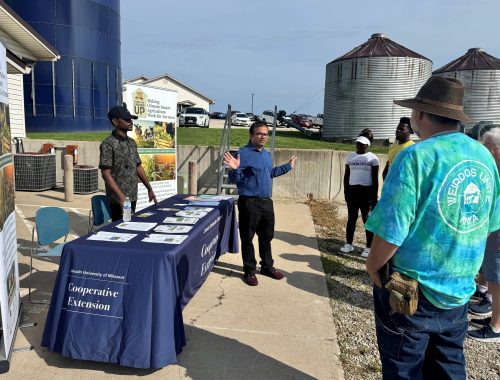
“All Hands Meetings” have brought together farmers and researchers across Ohio and Missouri to share early learnings from the project. Undergraduate student internships and on-farm gatherings are being planned for summer and fall. “I’m excited about hosting and supervising undergraduate interns from Central State University this upcoming summer as part of the project. The goal is really to give our students hands-on experience and increase interest and participation in science, technology, engineering and mathematics (STEM) fields,” says Dr. Tunsisa Hurisso, Associate Professor of Soil Science & Associate Director of Research at Lincoln University. Weather stations have also been installed on all participating farms to collect data on weather variability, and field data collection continues.


“Looking forward, I feel like we are ready for our first full growing season of data collection on all the participating farms. By next winter, I suspect we’ll begin to see some of the emerging results that will help answer the farmers’ different research questions,” says Dr. Jackson-Smith.
Although the FTGUp project is still in its early stages, it is already clear that when farmers lead research, the questions matter more, the results feel more important, and trust runs deeper. Across Ohio and Missouri, a new model for agricultural research is taking shape—field by field, farm by farm, and conversation by conversation
By Joseph Opoku Gakpo