Susan Jaster: A Trusted Voice Helping Farmers Rethink the Soil Beneath Them
For more than 40 years, Susan Jaster has been deeply connected to agriculture, continually adapting, learning, and finding new ways to make the land she depends on healthier and more productive. She started out in the dairy industry with her family in southwest Missouri, and is now based in west-central Missouri, where she runs a smaller operation, raising hair sheep.
“It’s a small operation, but we do a lot of good conservation practices and regenerative practices so that our sheep always have plenty of grass to eat. They’re healthy because they’re on healthy soils and good grass.”
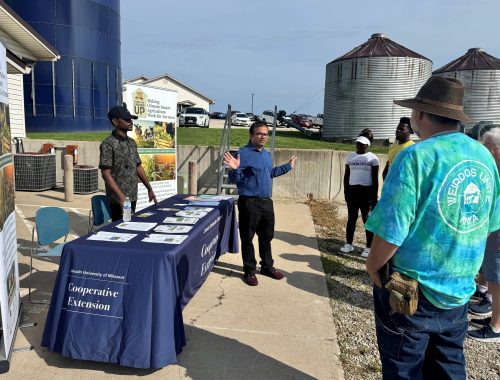
The philosophy that says healthy soil leads to healthy livestock has guided her work for years. Now, through the From The Ground Up (FTGUp) Project, Jaster is helping bring that message to other farmers across the region. “From The Ground Up project has allowed me to help other farmers become interested in soil health and using cover crops as a regenerative practice to improve their soil so that their livestock has great grazing.” “And it’s helping them to understand that cover crops can be a great way to make that transition from heavy chemical use practices to easier practices don’t require as many chemicals, and they still get good results,” she adds.
FTGUp is a farmer-led project in Ohio and Missouri, working to improve the real-world, on-farm performance of conservation practices across the Midwest. Backed by researchers from The Ohio State University, University of Missouri, Central State University, Lincoln University, and non-profit partner Solutions from the Land, farmers are designing their own research projects with scientists supporting them. Yield stability, protection from extreme weather, and profitability are key outcomes that the farmer-led research is investigating.
Jaster leads a group of eight livestock farmers in this research node in testing alternative seed treatment for cover crops. The research on field sizes ranging from half an acre to six acres, is comparing different methods of pretreating seeds for broadcasting annual cover crop species into pastures grazed by small ruminants. On each of the farms, pastures are divided into three different test plots. On the first field, a diverse mix of cover crops (BMR forage sorghum, hybrid pearl millet, forage soybeans, sunflower, and forage collards) is broadcast after being pre-treated with worm casting tea, a nutrient-rich liquid fertilizer derived from worm poop.
The second field has the same cover crops seed mix pre-treated with Green Lightning liquid fertilizer, a product created by mimicking the natural nitrogen-fixing effects of lightning. A third plot serves as a control, with untreated seed. Small ruminants move through the plots in carefully managed rotations, mirroring real farm conditions. Throughout the season, data is collected on forage yield, nutrient quality, plant diversity, soil health, and economic return.

Jaster says for many small-scale producers, the idea of using lower inputs to produce high-quality outputs is essential. “They want to use less inputs. And then sell a high-quality product for a premium price. And this helps them to convey that to their customers.”
But beyond market opportunities, Jaster sees the project as a catalyst for long-term change in how farmers think about their land and soil. “I believe that many of these farmers will adopt the practices that we’re using on the grant research because if they can see the difference in their soil from the beginning of the project and just how good their grass is growing, to what happens in the next few years, if they can learn that there’s a difference there, that’s a win.”
Through steady work, shared knowledge, and a focus on soil health from the ground up, Jaster is helping ensure that farmers are better equipped to succeed.
By Joseph Opoku Gakpo