The Best Research Findings Come From Nearby Farms, Says Missouri Farmer Josh Payne
On 300 acres of pasture in Concordia, Missouri, Josh Payne is reshaping what it means to farm. What began as a conventional row crop operation tied to family land has transformed into a diverse, pasture-based system. Today, Payne and his family raise about a thousand sheep as their primary enterprise, alongside about 60 hogs and an emerging 80-acre chestnut tree operation designed to bring long-term value to the farm.
But Payne’s journey into this farming system was far from straightforward. In fact, farming wasn’t even his first career. “I started off as a high school teacher… I taught high school English and was a basketball coach.”
It was a return to small-town life and family land that brought him back. At first, though, the work didn’t resonate. “I farmed with my grandpa… honestly didn’t really like it. It was conventional corn and soy. Spent a lot of time in a tractor. It was just something I didn’t really terribly enjoy.”
Then came a turning point that would change everything. “In 2020, I found out that I was allergic to herbicide. My body doesn’t eliminate toxins well… When my body builds up the toxins, then it overflows in my throat and causes eosinophilic reaction in my throat. Which doctor said eventually, if it gets bad enough, I will die from.”
Faced with a stark choice to leave farming or fundamentally change how he farmed, Payne chose transformation. “We decided I needed to go back to teaching, or I needed to switch the way we farm. So we decided that we should start grazing sheep.” Payne has now built a system that works with his health, his land, and his long-term goals.
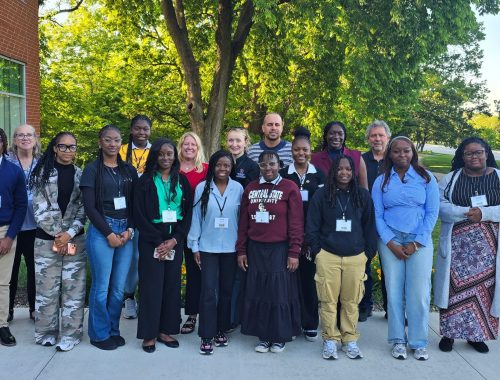
Payne is one of the farmer leaders on the From The Ground Up (FTGUp) project in west-central Missouri. FTGUp is a farmer-led project in Ohio and Missouri, working to improve the real-world, on-farm performance of conservation practices across the Midwest. Backed by researchers from The Ohio State University, University of Missouri, Central State University, Lincoln University, and non-profit partner Solutions from the Land, farmers are designing their own research projects with scientists supporting them. Yield stability, protection from extreme weather, and profitability are key outcomes that the farmer-led research is investigating.

Payne says one of the most brilliant things about this project is that it’s designed around real farms and working farm conditions, unlike traditional research conducted in controlled environments. “I know there’s a lot of distrust, … especially amongst farmers, from like big research institutions. But also because those are often done in very sterile environments where we’re going to just isolate all other factors.”
He says, “most of the farmers I know are highly skeptical of taking that kind of research and sticking it on their farm.” But they are more likely to adopt research findings “if they know this has been tried by farmers in their area. They’re able to come see it and they’re able to do it [too].”
For Payne, when the research is local, visible, and led by fellow farmers, findings carry heavier weight.