

From Service to Soil: A Veteran’s Mission to Build Better Farming
On a quiet 80-acre farm in west-central Missouri, Arthur Kanneman is building a livestock operation rooted in purpose, discipline, and a deep respect for the land.
A 24-year veteran of the United States Air Force, Kanneman brings a lifetime of technical skill and leadership to his work in agriculture. The 56-year-old previously worked as an aircraft machinist and welder, and retired as an Air Force communications project manager.
In 2015, he traded military life for rural Missouri, where he established a small but diverse farm. Today, his land supports Scottish Highland cattle, meat goats, horses, dairy goats, and a host of other animals, all managed under a rotational grazing system designed to work with nature and support friends. “The reason we got into it was probably to provide quality, healthy, nutritious meat for us and our friends.”
That commitment to quality extends to how he manages his land. Avoiding chemical inputs whenever possible, Kanneman relies on practices like cover cropping and rotational grazing to maintain soil health and productivity. “We don’t really apply any chemicals to the ground. We do cover crops when we can.”
Now, he’s taking that commitment to improving his fields a step further by participating in the From The Ground Up (FTGUp) Project. FTGUp is a farmer-led project in Ohio and Missouri, working to improve the real-world, on-farm performance of conservation practices across the Midwest. Backed by researchers from The Ohio State University, University of Missouri, Central State University, Lincoln University, and non-profit partner Solutions from the Land, farmers are designing their own research projects with scientists supporting them. Yield stability, protection from extreme weather, and profitability are key outcomes that the farmer-led research is investigating.
The research in this farmer node on field sizes ranging from half an acre to six acres, is comparing different methods of pretreating seeds for broadcasting annual cover crop species into pastures grazed by small ruminants. On each of the eight participating farms, pastures are divided into three different test plots. On the first field, a diverse mix of cover crops (BMR forage sorghum, hybrid pearl millet, forage soybeans, sunflower, and forage collards) is broadcast after being pre-treated with worm casting tea, a nutrient-rich liquid fertilizer derived from worm poop. The second field has the same cover crops seed mix pre-treated with Green Lightning liquid fertilizer, a product created by mimicking the natural nitrogen-fixing effects of lightning. A third plot serves as a control, with untreated seed. Small ruminants move through the plots in carefully managed rotations, mirroring real farm conditions. Throughout the season, data is collected on forage yield, nutrient quality, plant diversity, soil health, and economic return.

Kanneman is dedicating about an acre to this study and is particularly looking forward to the research results of how their treatments will improve soil health. “I hope to learn from this project a little bit more, what I can do to help the world be a little bit better for the next generation. And then the soil. Microorganisms and everything start from the ground. And from that ground is what we eat to nourish our bodies.”
With a foundation built on service, stewardship, and a willingness to learn, Kanneman is working to ensure that what grows from his soil today will help nourish a better tomorrow.
By Joseph Opoku Gakpo


You May Also Like
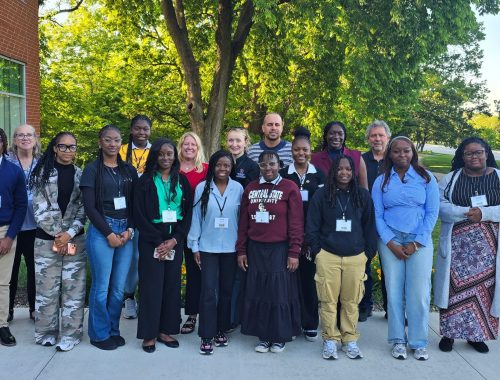
Central State University and Lincoln University Students Embark on 10-Week Internship Journey with From The Ground Up

A Missouri Livestock Farmers’ Bet on a Stronger Future for Small Farms Through Farmer-led Research
