The Rotation Equation: Beef Cattle Grazing in Ohio and Missouri
Management-intensive rotational grazing (MIRG) has a strong case behind it.
Move cattle through subdivided pastures more often, give pasture time to rest and recover, and the literature shows real gains: longer grazing seasons, lower feed costs, better soil structure, drought resilience, and in many studies, higher net returns per acre than continuous grazing (also called ‘open pasture’ grazing). These results are especially consistent in the humid pasture regions that cover much of Ohio and Missouri. However, the practice may not be as widespread as the benefits suggest it might be.
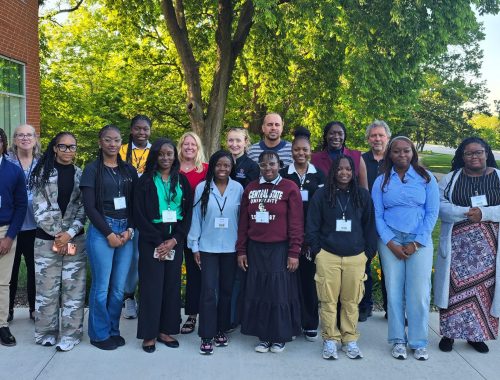
I’ve been digging into this gap for my research within the From the Ground Up project, a five-year USDA-funded effort between Ohio State University, Central State University, Lincoln University of Missouri, the University of Missouri, and Solutions from the Land, that works directly with farmers and ranchers – giving them the lead to figure out why conservation practices that look good on paper don’t always show up in the field.
Our team’s baseline farmer surveys this spring gave me a clearer answer than I expected.
The 2025 Ohio and Missouri Farm Polls told us that about half the farms we surveyed in both states raise livestock, and more than 90 percent of those farms graze regularly. We asked how often beef cattle graziers rotated their animals to fresh pasture and sorted them into four groups: “continuous” graziers who never move animals during the season, “moderate” rotational graziers who rotate paddocks less than once a month, “moderate-intensive” rotational graziers who rotate once a week or less, and “intensive” rotational graziers who rotate more than once a week (which we use as a working definition of ‘MIRG’).
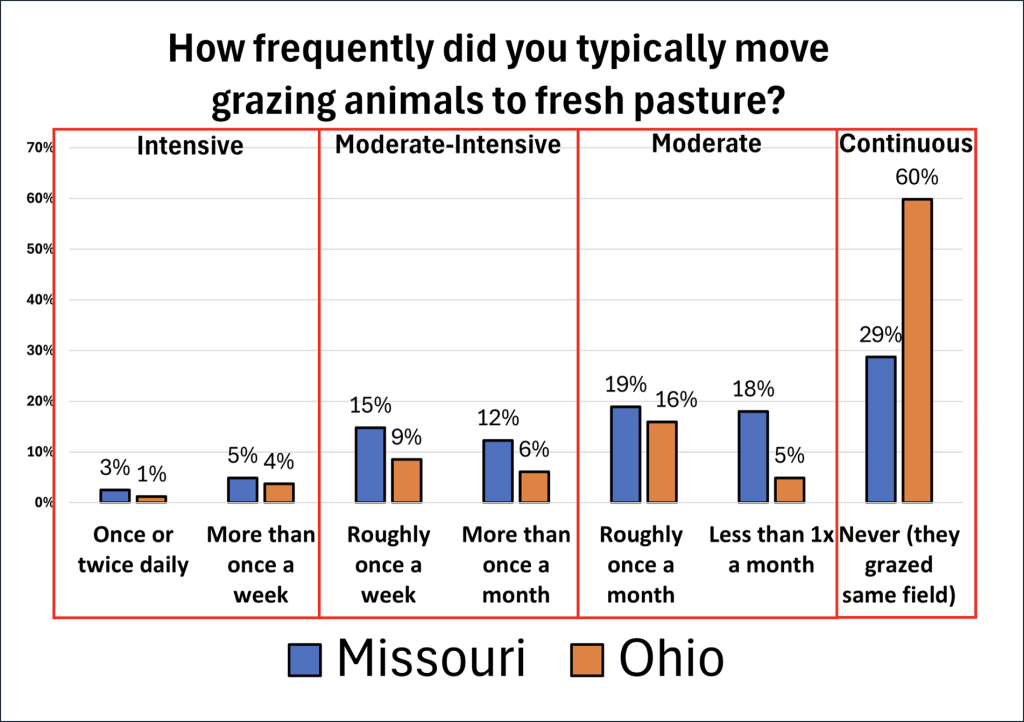
- Continuous graziers: 60% in Ohio, 29% in Missouri
- Moderate rotational graziers: 21% in Ohio, 37% in Missouri
- Moderate-intensive rotational graziers: 15% in Ohio, 27% in Missouri
- Intensive rotational graziers: 7% in Ohio, 5% in Missouri
So somewhere between one in twenty and 1 in fourteen in our sample is using MIRG.
What I didn’t expect was how many of the beef cattle operators already agree with the case for MIRG. We asked every beef cattle grazier, not just the ones already rotating frequently, whether they thought MIRG would help their operation. Nearly 80 percent agreed it would improve soil quality and pasture productivity. About two-thirds thought it would lower their feed costs and said they were confident they could manage it. More than half (56 percent) even agreed it would be profitable. Even among continuous graziers, the group doing the least rotation, 74 percent still said MIRG would help their farm’s soil health.
These results tell us that belief doesn’t look like the adoption bottleneck. Most farmers in our sample already think MIRG is more productive, profitable, and better for soil health.
What separates the people who agree with MIRG from the people who practice it is what they think it would cost them to switch. Two-thirds of all beef cattle graziers said MIRG would require fencing they don’t currently have, and that share rises steeply as grazing intensity drops (from 30 percent among intensive graziers up to 80 percent among continuous graziers). Farmers who responded that MIRG would be “difficult to implement” follows almost the same curve: 6 percent among intensive graziers, 75 percent among continuous graziers. Land access and labor time show similar perception gaps.
It also fits with something that’s bothered agricultural economists for a while. Decades of extension programming, case studies, and field days haven’t moved national adoption rates much, and in some datasets, adoption has declined since the 2000s. If skepticism were the real problem, that messaging should have worked by now, shouldn’t it? The more consistent explanation across studies, and now our own data, is not a disbelief in the science. Our data points toward infrastructure needs like water access, fencing costs, rented land, and training and labor needs, the time it takes to learn a rotational system.
That distinction matters for how From the Ground Up approaches this work. We’re not starting from the assumption that graziers need to be convinced. Nearly three-quarters of continuous graziers believe MIRG would be difficult to implement, and limited land access remains a concern for many producers. Our grazing nodes are working through some of these challenges by finding ways to increase forage yields and improve forage quality on the land they already have. They’re experimenting with soil amendments, lime application, warm-season annuals, and adjustments to mid-season grazing management. For producers working on smaller acreages, these approaches may help make more intensive grazing practical without requiring additional land.
Improving pasture productivity explains a lot of the mechanics, but they only get at part of the gap and not why two farmers with similar fencing, water access, and land end up making very different grazing decisions. That has intrigued me to look at the sociological side of ‘conservation agriculture adoption’ alongside our survey results. I am interested in the way family goals, household needs, community ties, identity, market access, connections to the land, and social norms about what counts as “good farming” influence approaches to grazing. I want to further examine how social and structural forces shape decisions that may look purely economic from the outside. Those factors are harder to survey than fencing costs, but they may carry as much weight in explaining who rotates their cattle more frequently and who doesn’t. That’s the next piece of this work– I’ll be writing more about my analysis of nearly 50 interviews I’ve conducted with beef cattle graziers in Ohio and Missouri. Stay tuned!
By Alex Rehbinder.
Alex Rehbinder is a graduate student at The Ohio State University.
Read more about the results from the 2025 Ohio and Missouri Farm Polls, here.